

From the Florida Flats to the High Desert: The Paintings & Assemblages of William Bock
After decades in Florida, where the landscape is defined by its flatness and the seasons blur from one humidity into the next, Cedar Crest artist William Bock and his wife, Maria Trinidad Sotolongo, were looking for a place where Mother Nature changes her clothes. For five years, the search was on. It was a quest not just for a new home, but for a new horizon—literally and figuratively.
They wanted trees. They wanted the crisp change of autumn and winter. They wanted the vertical drama that only the places like the East Mountains area can provide.

“We wanted a proximity to vegetation and the changing of the seasons that was a little more dynamic,” Bock explains from his home in Cedar Crest. “Coming back on our fifth year of looking, we came through Cedar Crest, and we saw trees… and we just fell in love with a house that was in disrepair. But we like challenges.”
Those challenges—fixing up an old house and preserving the land—mirror Bock’s creative philosophy. It is about looking beneath the surface, understanding the structure of things, and assembling what appears to be a jumble into a cohesive, beautiful whole. Now settled in the East Mountains, having left Florida behind just last August, Bock has brought with him a lifetime of artistic evolution that began long before he ever picked up a brush.
A Lineage of Art and Intellect
To understand Bock’s work, one must look at the architecture of his childhood. He was born into a studio. His mother, Marylou Bock, was an intellectual who taught English at Princeton University and the Institute for Advanced Study. His father, Ernest Bock, was a man of duality—a Korean War combat veteran who worked for UNIVAC (the creators of the first commercial computer) by day, and a passionate painter by night.
Some of Bock’s earliest memories are framed through the banisters of a second-floor landing, peering down at his father.
“He would work long hours for the computer company, and then he would come home and paint,” Bock recalls. “He and his friend painting naval battles… having martinis and laughing and listening to classical music or the Midnight Special. I wanted that for myself.”
At age five, Bock set up his own easel next to his father’s, copying Matisse and learning that art was not just a hobby but a way of life. It was a destiny further cemented by childhood trips to Chicago museums, staring into dioramas and cross-sections of the human body, fascinated by what lies inside and underneath.

The Geology of the Box
While his time in Florida was commercially successful—Bock spent years painting marine wildlife for a market that demanded sea turtles and sport fish—he eventually felt constrained by the geography.
“The horizon was so flat,” he says. “I started thinking, since the horizon was so flat, what’s up and what’s down?”
This curiosity sparked a transition from painting to Bock working on “assemblages”—three-dimensional, vertical boxes that serve as geological and historical core samples. They are mixed-media pieces that they scientific art and spiritual narratives. One signature piece, From the Core, acts as a frozen cross-section of time, anchoring a specific location from the limestone base of the earth, up through the mangroves, and into the cosmos, locking in the position of the stars of a particular date via Google Star Maps.
His move to New Mexico has only deepened this fascination with strata. Influenced by the Taos Pueblo, which is built into the rock rather than just on it, his new work explores the layers of the Southwest. He collects fossils, copper veins, and desert wood, orchestrating them inside boxes that recall the wonder of artist and filmmaker Joseph Cornell and the educational dioramas of his youth.
“I’ll go thrift shopping with my wife, and I’ll just be attracted to toy cars, shiny rocks, and objects,” Bock says. “But now, as an adult knowing something about science and geology, I’ll put them together… It’s like a solid puzzle.”
The Art of Reaffirming Life
Bock’s multi-artist project gallery in Cedar Crest operates on a philosophy distinct from the high-pressure commercial art world. It is an artist-run space, designed to be an interactive experience rather than a transaction. For Bock, the purpose of art isn’t only aesthetic pleasure, but a connection to the past and a hope for the future.

“The meaning of art is really to reaffirm life,” he says, echoing advice from a former professor. “If it raises questions, it makes you marvel at the wonder of what came before… that’s what I would hope people take away.”
This appreciation for life and human connection is deeply personal, particularly for Trinidad. A native of Cuba, she escaped the communist regime at age 11. Her family lost everything—her grandfather was forced to live in a shack behind the store he built, and her family members were imprisoned.
“It makes us realize how lucky we are here,” Bock reflects. The move to New Mexico has been a breath of fresh air in more ways than one. Unlike the hurried, often aggressive pace of modern urban life, Bock finds the community in Cedar Crest and the East Mountains area to be “sincere.”

“It’s so refreshing to be back in a place where people acknowledge each other… where you have time to stop and look at the beauty around you.”
A Continuing Legacy
Today, Bock’s studio is a testament to a life spent observing. Whether it is a 3D topographical map of the Abiquiu area or a box telling the story of a fossil found in Monument Valley, the work is about perspective. It is about changing the angle just enough to see the mountain differently.
For a man who once cast bronze earth spirals for Georgia O’Keeffe in a New Jersey foundry, landing near Ghost Ranch feels like a circle completed. But he isn’t finished yet. His advice to the next generation is simple: keep making art.
“You’re always an artist when you’re making art,” Bock insists. “It gives you hope that when you’re gone, your art continues, people continue… and we all become part of each other’s experience.”
EDITOR’S NOTE: See the world through Bock’s eyes at East Mountain Fine Art and Wonder in Woods Gallery, located at 12418 NM-14, Cedar Crest, NM 87008, where you will find him surrounded by the ancient geology of the mountains and the assembled memories of a lifetime. That experience is on full display—layer by beautiful layer.
Bock is the curator of East Mountains Fine Art and Wonder in the Woods Gallery, a shared space with chainsaw woodcarver Isaac Trujillo, custom woodworker Jeremy Tolman, and sun pyrographer/artist Timothy Willis.

Isaac Trujillo: The Wood Whisperer of Cedar Crest

MADRID: Where Coal Dust Turned to Stardust & One of New Mexico’s Best Parades
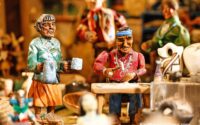
The House That Quarters Built: The Singular Vision and Lasting Legacy of Tinkertown
About The Author
