

NMDOT Public Meeting on Roundabout set for Thursday
The New Mexico Department of Transportation is holding a public meeting on April 2 at Estancia Valley Classical Academy at 6 pm to share information about its finding of a study of the NM 333 and Mountain Valley Road intersection.
While the NMDOT’s traffic and safety analysis indicates a roundabout is the best option for the intersection, the project’s team would also like to hear your questions and comments about the proposed intersection improvements.
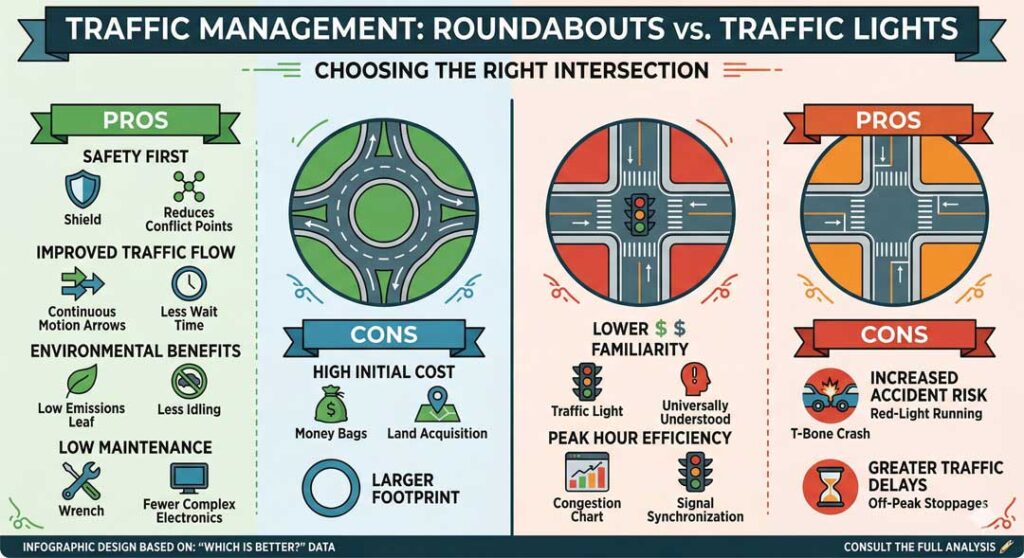
Comparing Roundabouts to Traffic Signals
Building a roundabout versus installing a traffic light is a significant decision for any intersection. Each approach offers distinct advantages and disadvantages that influence safety, efficiency, cost, and community impact. To help illustrate these differences, here is a breakdown of the key pros and cons of each option.
Building a Roundabout
A roundabout is a circular intersection where drivers travel counterclockwise around a center island. There are no traffic signals or stop signs; drivers yielding to traffic already in the roundabout.
Pros of a Roundabout:
- Improved Safety: This is perhaps the most compelling benefit. Roundabouts have fewer conflict points where vehicles can collide compared to traditional intersections.
- Reduced Conflict Points: A typical four-way intersection has many potential points of conflict for turning and crossing movements. A roundabout, by design, merges all traffic into one continuous flow, significantly reducing the opportunities for T-bone or head-on crashes.
- Lower Speeds: Drivers must slow down to enter and navigate a roundabout. In the event of an accident, these lower speeds dramatically reduce the severity of injuries and the extent of property damage.
- Greater Traffic Efficiency: Roundabouts often yield better traffic flow and reduced delays, especially during non-peak hours.
- Continuous Flow: Vehicles don’t have to come to a complete stop if there is no conflicting traffic. This continuous yield-controlled movement keeps traffic moving more smoothly.
- Increased Capacity: Contrary to some common misconceptions, well-designed roundabouts can handle more traffic, especially left-turn movements, more efficiently than traffic signals in many scenarios.
- Reduced Environmental Impact:
- Lower Emissions: Reduced idling time at red lights leads to lower vehicle emissions and improved air quality.
- Less Noise: Without the constant stop-and-go from traffic signals, roundabouts can be quieter.
- Lower Long-Term Maintenance: Roundabouts don’t rely on complex and costly electronic systems like traffic signals, leading to fewer maintenance needs and associated costs over time.
- Aesthetics and Placemaking: The central island of a roundabout can be landscaped, providing an opportunity for artistic elements or green space that can enhance the local environment.
Cons of a Roundabout:
- Higher Initial Cost and Space Requirements:
- Construction Expense: Roundabouts typically have a higher upfront design and construction cost than traffic lights.
- Larger Footprint: They require a larger physical area, which can be a significant challenge in urban settings with existing infrastructure or where acquiring new right-of-way is difficult or expensive.
- Learning Curve for Drivers: In areas where they are uncommon, roundabouts can be confusing and intimidating for some drivers, potentially leading to initial confusion or minor side-swipe accidents as the public adapts.
- Less Effective Under Extreme Traffic Conditions: In cases of extreme congestion or a highly dominant traffic flow in one direction, roundabouts can experience “lock-up” and become less efficient than a properly timed traffic light.
- Challenges for Pedestrians and Cyclists:
- Perceived and Actual Difficulty for Pedestrians: While statistically safer for pedestrians due to lower speeds, navigating multiple crosswalks at a roundabout, especially without signal control, can feel more daunting for some, particularly for those with visual or mobility impairments.
- Cyclist Navigation: Navigating a multi-lane roundabout can be more challenging and intimidating for cyclists compared to a signalized intersection where they may have dedicated signals or clearer lanes.
Installing a Traffic Light
A traffic light (or traffic signal) uses red, amber, and green lights to control the flow of traffic through an intersection.
Pros of a Traffic Light:
- Established and Familiar: Drivers are globally familiar with traffic lights, requiring no new learning curve.
- Lower Initial Cost and Smaller Footprint:
- Cost-Effective Setup: Installing signals can be less expensive upfront than building a roundabout.
- Compact Design: They fit within a much smaller physical space, making them ideal for tight urban environments.
- Effective Under High Traffic Volumes and Peak Hours: Traffic signals are excellent at managing very high volumes of traffic. They can be programmed and coordinated with neighboring signals to maximize flow and reduce overall travel time during peak commute hours.
- Predictability and Control: Traffic lights provide a clear, deterministic control of right-of-way, which some find more orderly.
- Easier for Pedestrian Crossings: Standard pedestrian signals (like the “Walk/Don’t Walk” sign) are well-understood and provide dedicated, protected crossing times, which can be safer and more comfortable for pedestrians, including those with disabilities.
- Prioritization Capabilities: Signals can be equipped with technology to prioritize emergency vehicles or public transit (bus pre-emption), a feature not as easily or effectively integrated into standard roundabouts.
Cons of a Traffic Light:
- Increased Potential for Severe Accidents:
- More Conflict Points: The multiple crossing and turning paths at a signalized intersection create significantly more opportunity for serious side-impact (T-bone) and head-on collisions, especially from red-light running.
- Higher Speeds: Traffic approaching a green light is typically traveling at full speed, increasing the severity of any accident that does occur.
- Greater Traffic Delays and “Dead Time”: Traffic signals inherently cause delays, as vehicles must stop even when no cross traffic is present. This is particularly noticeable during off-peak hours, leading to user frustration.
- Higher Environmental Impact: The repeated stopping and starting, along with idling at red lights, leads to higher fuel consumption, increased greenhouse gas emissions, and greater noise pollution compared to the continuous flow of a roundabout.
- Higher Long-Term Maintenance and Operating Costs: Traffic signal systems require ongoing electricity to operate and regular maintenance of complex electrical and electronic components. They are also subject to power outages and malfunction.
- Less Aesthetically Versatile: Intersections with traffic lights can be more visually cluttered with poles, wires, and control boxes, with limited opportunity for landscaping or placemaking compared to the potential of a roundabout’s central island.
Summary Comparison
When deciding between a roundabout and a traffic light, engineers and community planners must carefully weigh these competing factors. The optimal choice is rarely universal and depends heavily on specific local conditions, including traffic volume, available space, cost, the surrounding environment, and community priorities regarding safety, efficiency, and aesthetics.
Can’t attend the meeting
NMDOT recognizes that community feedback is a vital part of the project process and helps ensure the improvements reflect local needs. All comments received during the public comment period, at the meeting or through the mail, email, and online comment form, will be reviewed by the project team.
Please share them with us by May 2, 2026.
MAIL: 4041 Jefferson Plaza NE, Ste 210, Albuquerque, NM 87109
EMAIL: NM333-217Improvement@parametrix.com
PHONE: (505) 998-5576

Rodriguez Fans 10 Batter, Lady Pintos Top Hot Springs

Moriarty’s Cash Klein named to Class 4A All-State second team

Young Pintos Squad Looks to the Long Game After Tough Road Loss to Bernalillo
About The Author
