
The Moriarty Shortcut: How a Cross-Country Footrace Helped Bring Route 66 to the East Mountains
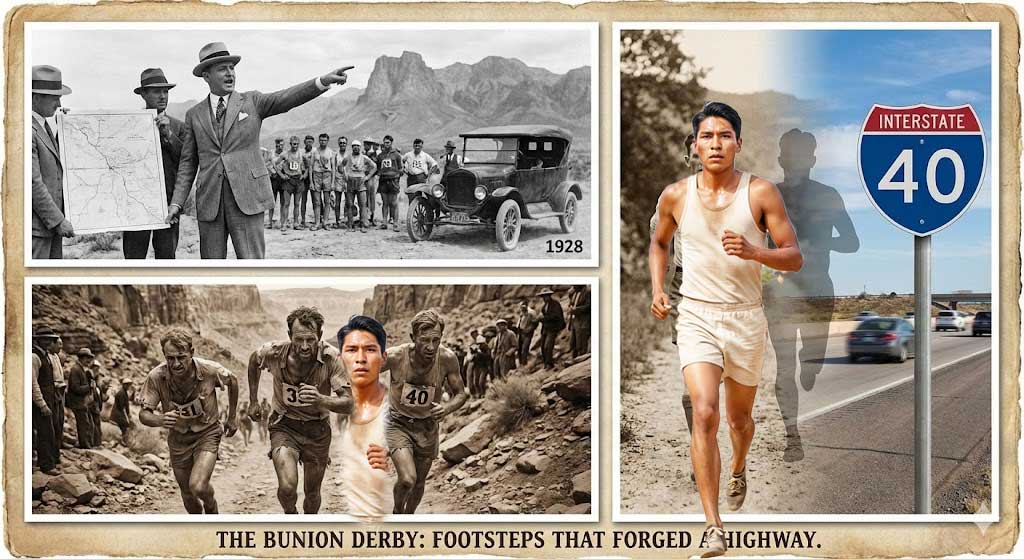
TIJERAS, N.M. — While the 1928 “Bunion Derby” was a cross-country spectacle, it was the steep, rugged slopes of the East Mountains that fundamentally altered the geography of the American West.
Officially dubbed the “First International Trans-Continental Footrace,” the event was the brainchild of flamboyant sports promoter C.C. “Cash and Carry” Pyle. It was designed as a rolling publicity stunt for the newly commissioned “Main Street of America,” U.S. Route 66. Pyle offered a staggering $25,000 grand prize—a life-altering fortune in the pre-Depression era—to the winner.
The cynical press corps, noting the immediate and devastating physical toll on the participants, quickly coined a more lasting moniker for the event: The “Bunion Derby.”
The race didn’t just test the endurance of the 199 men running from Los Angeles to New York; it served as the catalyst for rerouting the “Main Street of America,” carving a path through the Sandia foothills that would eventually become the blueprint for Interstate 40.
The Great Santa Fe Detour
In 1928, the official alignment of U.S. Route 66 was a winding, northward loop. Travelers heading east from Albuquerque were required to drive up to Santa Fe before cutting back down toward Santa Rosa.
However, the race’s promoter was more interested in cash than official maps.
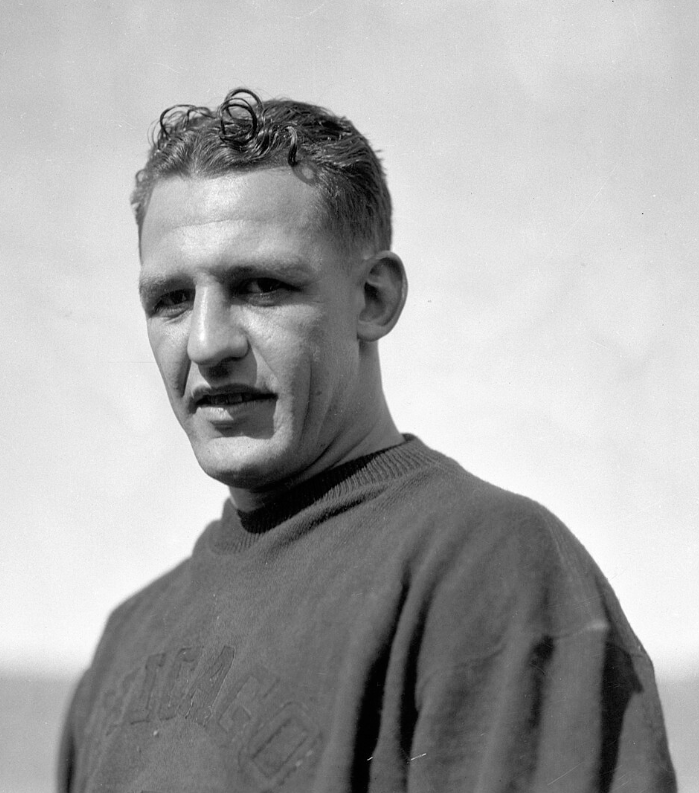
Pyle, ever the showman, turned the suffering into commerce. The runners were trailed by a two-mile-long motorcade that included a traveling sideshow featuring vaudeville acts, football legend Red Grange (who was employed by Pyle), and a rolling radio station broadcasting daily updates of the misery to a captivated nation.
Towns along Route 66 were charged “hosting fees” by Pyle for the privilege of having the exhausted men jog down their main streets, a practice that led to some significant detours.
When Santa Fe city fathers refused to pay Pyle’s $5,000 “hosting fee,” he looked toward the imposing wall of the Sandia Mountains and made a decision that would change New Mexico history.
Pyle ordered the “bunioneers” to bypass the capital entirely. He directed the exhausted runners east out of Albuquerque, forcing them into a grueling ascent through the narrow, rocky throat of Tijeras Canyon.
Conquering the East Mountain Grade
For the runners, the East Mountain leg was a nightmare of verticality and thin air. After weeks of flat desert running, the men hit the steep grades of what is now the village of Tijeras. At an elevation gain of nearly 2,000 feet in a single afternoon, the “thin air” became as much an enemy as the gravel underfoot.
Local residents from Cedar Crest, Edgewood and the surrounding mountain hamlets lined the canyon walls to witness the strange parade. The runners passed through the heart of the canyon, navigating the same rugged terrain that today’s hikers explore on the Travertine Falls and Fulty trails.
As they crested the pass and descended into the Estancia Valley, the runners crossed into Moriarty. This “shortcut”—roughly 90 miles shorter than the Santa Fe loop—proved that a direct eastern route was not only possible but vastly more efficient for transcontinental travel.
The Quiet Oklahoman
Amid the chaos, injuries, and promotional noise, one runner maintained a metronomic consistency. Andy Payne, a 20-year-old Cherokee farmhand from Oklahoma, had no professional running experience, but he ignored the initial sprints and intense rivalries. He adopted a shuffling, energy-conserving trot that allowed him to average roughly 40 miles a day, every day, for nearly three months.
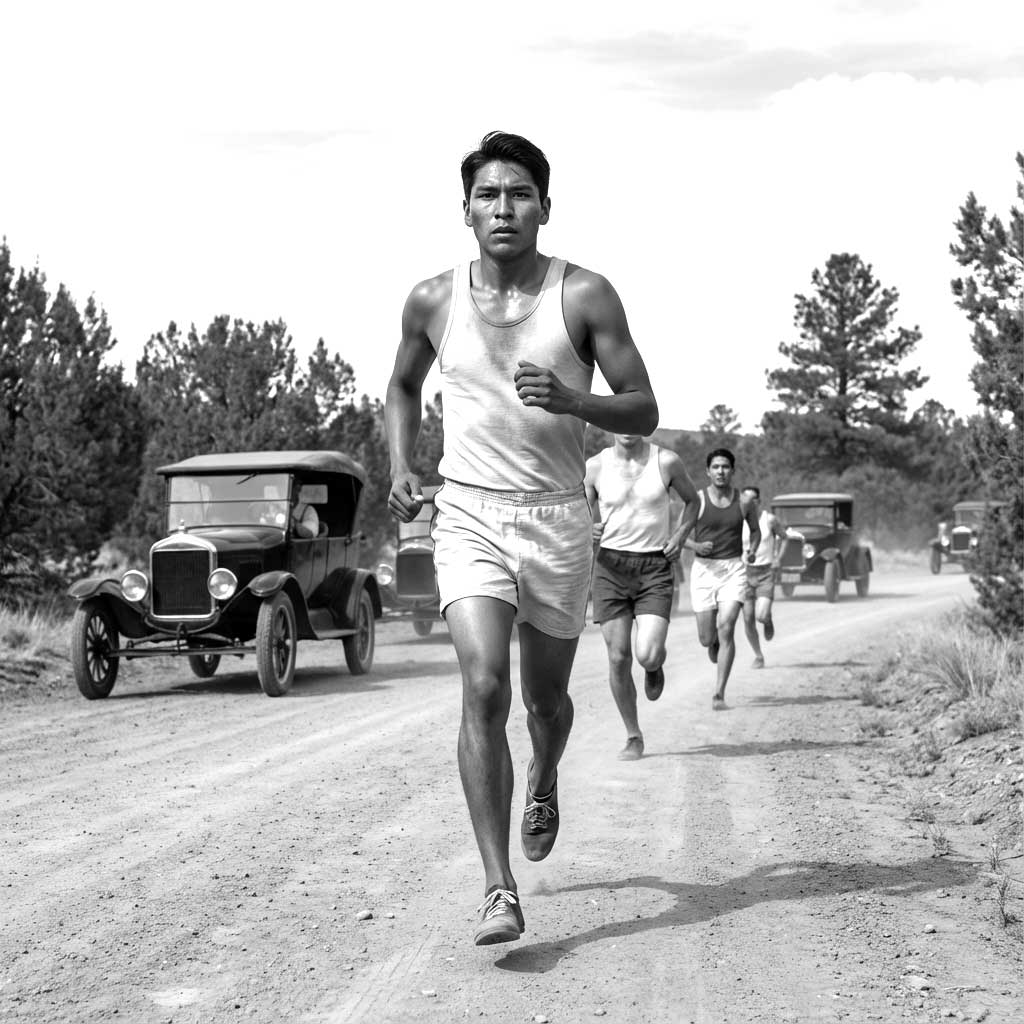
On May 26, 1928, after 84 days and a cumulative 573 hours on the road, Payne entered Madison Square Garden to claim victory. Only 55 of the original 199 starters completed the journey.
While “Cash and Carry” Pyle reportedly lost money on the complicated venture, Payne used his winnings to pay off the mortgage on his father’s farm. The Bunion Derby remains a singular testament to human determination, desperation and the bizarre excesses of the Roaring Twenties—a fleeting moment in history when running across a continent seemed like a reasonable way to earn a living.
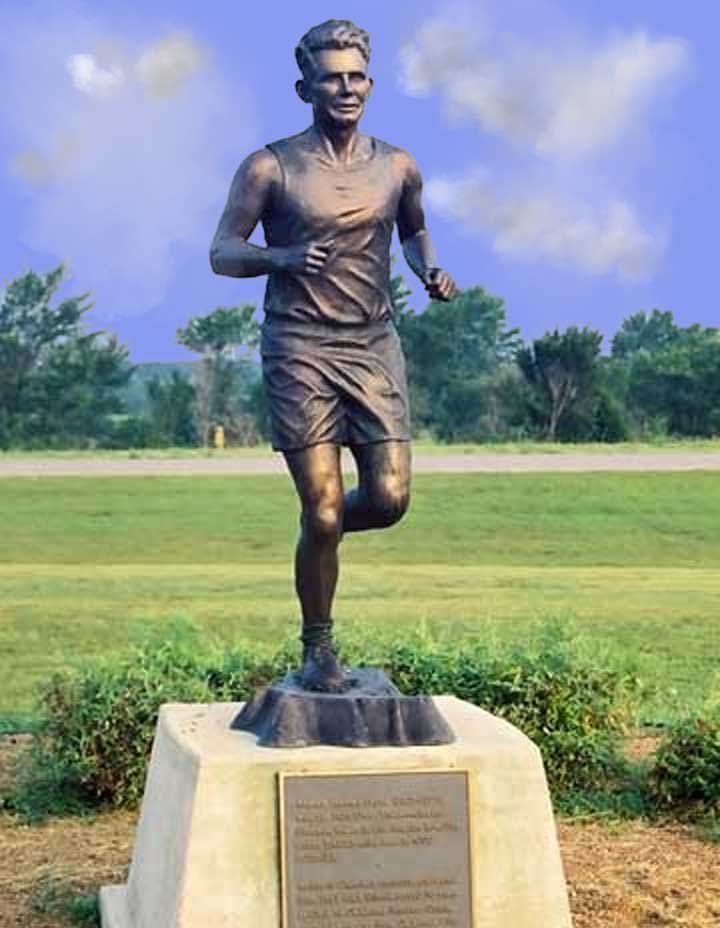
Payne would later work as the Clerk of the Oklahoma Supreme Court for nearly four decades. He passed away in 1977, and a memorial statue in his hometown of Foyil, Oklahoma was raised in 1992 to honor his accomplishments.
From Footpath to Interstate 40
The success of the Bunion Derby’s detour didn’t go unnoticed by New Mexico state engineers. The race proved that the “Moriarty Shortcut” was the future of commerce. In 1937, Governor Arthur T. Hannett lost reelection and as a “parting gift” to the Santa Fe Ring helped rewrite Route 66’s path.
Decades later, when the federal government began planning the Interstate Highway System, they looked at this established corridor. The grueling path carved by Andy Payne and his fellow “bunioneers” through Tijeras Canyon and across the plains of Moriarty became the foundation for what is now Interstate 40.
Today, as thousands of vehicles roar through the canyon daily, most are unknowingly following the footsteps of 55 men who, 97 years ago, ran through the mountain brush to prove that the shortest distance between two points was a straight line through the heart of the East Mountains.
Local Forest Service Employee Turns Childhood Project into Debut Novel, Spur Award Finalist
The House That Quarters Built: The Singular Vision and Lasting Legacy of Tinkertown
Fast, Furry, and Free: Flyball Takes Flight in Edgewood
About The Author
