

DONALD LAUGHLIN: 100-year-old Moriarty veteran recalls the day the Kamikazes came
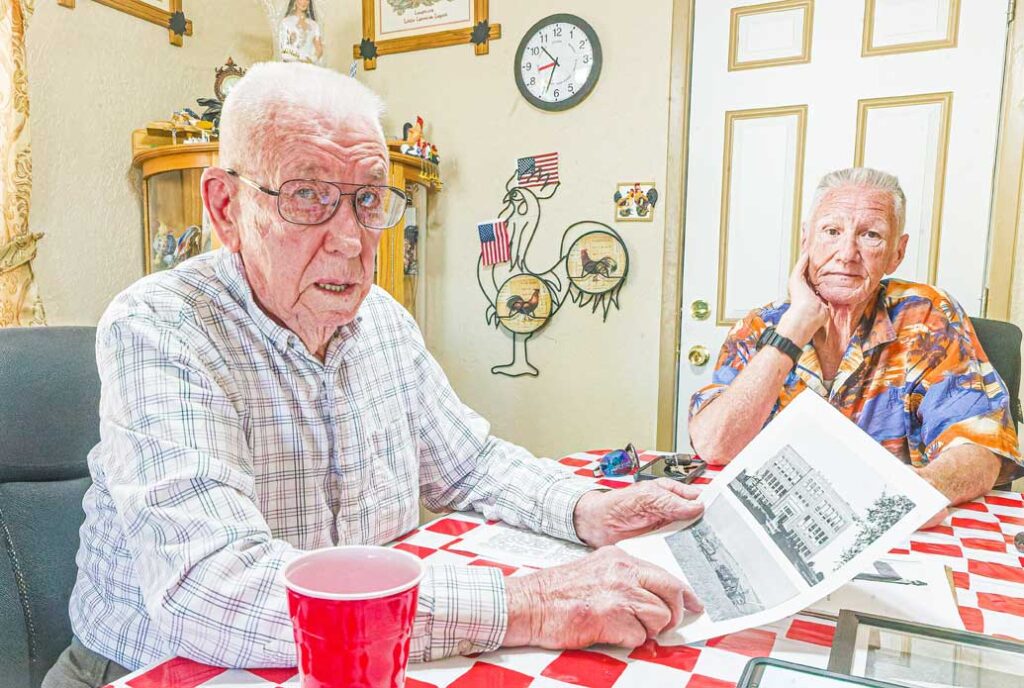
A hundred years is not just a measure of time; it is a tapestry woven with the threads of national sacrifice, rural American grit, and quiet, enduring love. For Donald Laughlin, who celebrated his 100th birthday on July 27, his life embodies a full century—a life marked by the chaos of a kamikaze attack on the USS Bunker Hill and the steadfast order of a master carpenter.
Donald speaks in measured, sometimes hesitant, tones. Yet, the memories, particularly those from 1945, remain sharply etched.
He tells his story at the dinner table in his Moriarty, NM home alongside his wife, Phyllis, a woman whose warm presence, sharp memory, and better hearing help fill in the gaps of Donald’s poor hearing, which is a result of decades of exposure to loud saws and power tools.
Born on a Malvern Mail Route
Donald was born in a very American way: in the country on a mail route in Malvern, Iowa. Not in a town or a hospital, but at home—a simple fact not uncommon for his generation. He recounts a childhood spent between his mother’s and father’s parents, growing up in a place that served as a residence and a schoolhouse, a building he believes still stands today.
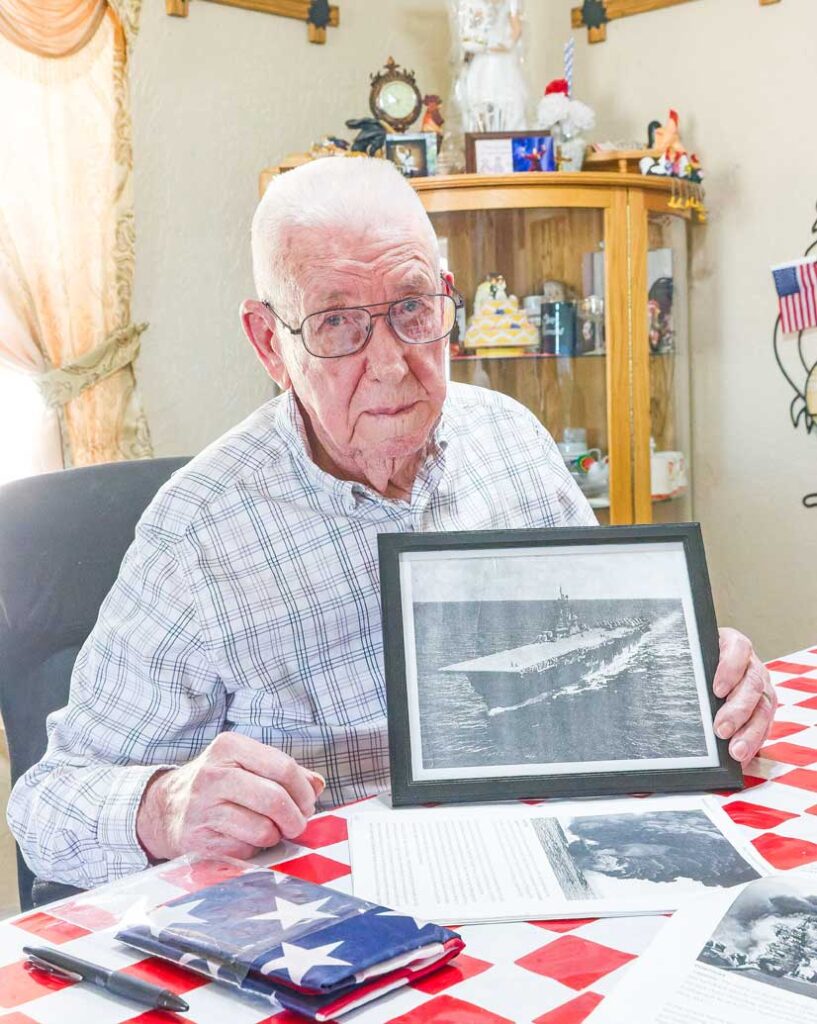
His parents, Eleanor Irene Johnson and Herbert Dale Laughlin, were a part of the backbone of the Midwest. Herbert was a farmer and did “custom hauling.” Donald was the youngest of four (two sisters and one brother, all now deceased).
His early life was shaped by a sense of community service, even before he wore a Navy uniform. Around high school age during World War II, Donald helped with the scrap iron drive, assisting in a local blacksmith shop to process old, discarded metal for the war effort—a humble but necessary contribution to the machinery of global conflict.
From Iowa Farm to the Pacific Ocean
The world changed for Donald in 1944. He had been deferred from military service a couple of times through the intervention of his grandfather, but as the war drew to a fever pitch, the need for manpower grew urgent. “Toward the end of the war,” he joked, “I guess they were scraping the bottom of the bucket. They called me up.”
Donald was inducted in Des Moines, Iowa, and traveled by train to the Naval Training Station at Farragut, Idaho, for basic training. He remembers it simply: “That was a lot of walking.” After basic training, he was assigned to a six-week course in electricity, a skill that would determine the entirety of his naval career.
Soon after, he was transferred to the aircraft carrier USS Bunker Hill (CV-17). The shift from the landlocked Midwest to the vast expanse of the Pacific Ocean and the sheer scale of a major warship must have been staggering. As a Fireman First Class, he wasn’t on the flight deck; he was assigned to the forward distribution panel for electricity—the core nervous system of the carrier. He stood watch, four hours on and eight hours off, down in the compartmentalized belly of the ship.
The Day the Kamikazes Came
When he wasn’t on duty, one of Donald’s favorite things to do was watching the pilots take off and land. Still, the experience that defined Donald’s service—and the single event he remembers most vividly—occurred on May 11, 1945, near Okinawa.

On that morning, Donald was on mess cook duty, assigned to the spud locker (where he prepared vegetables) just outside the forward mess hall. He was sitting and writing a letter home to his parents when the explosions hit. Two Japanese kamikazes, aircraft deliberately piloted into the ship, struck the Bunker Hill.
“I heard the explosions, I was afraid the magazines were gonna blow up,” he recalled.
One bomb, or perhaps shrapnel from a near-miss, provided Donald with a grim souvenir. A piece of shrapnel, about 1.5 inches in size blasted through the side of the ship, lodging perfectly into the hatch coming into the room.
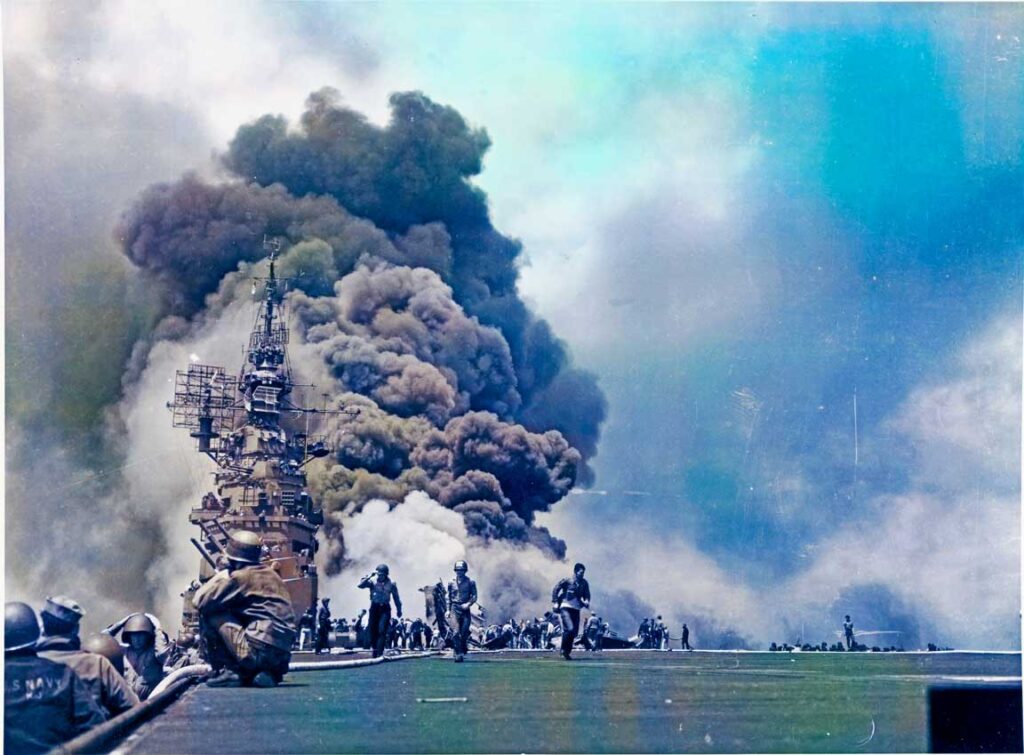
“That’s when a piece of shrapnel, about yay big, came through the side, right where I would have been standing about 15 minutes later.”
He held onto that piece of metal. It’s now kept by his daughter in Florida, alongside his Navy uniforms and memorabilia. It’s a tangible link to a day of horror that claimed 346 lives and wounded hundreds more—including many pilots who were killed instantly in the ready room by a direct hit.
Donald’s immediate peril was the smoke. The ventilation system sucked the black, toxic fumes from the burning flight and hangar decks down into the compartments below. He scrambled for a gas mask and, with other sailors, searched for a way out. They eventually located a hatch and climbed to the relative safety of the hangar deck, emerging from the smoke-choked metal maze.
Despite the carnage around him, Donald was uninjured. In fact, he was fortunate enough to get through his nearly two years of service without a scratch, save for one memorable incident: cutting his finger on a box of cereal while getting ready for breakfast and having to visit the sick bay for a patch-up.
Life as a Carpenter: The Orderly Life
Upon returning to the States, Donald went home to Strahan, Iowa. The Navy electrician training, however, did not immediately lead to an electrical job. He used his veteran’s assistance to embark on a career that would occupy the rest of his working days: carpentry.
“Woodworking is my main hobby,” he stated with quiet pride.
His orderly nature, noticed by Phyllis (“Everything had to be just so”), made him a master craftsman. His hands, which once helped keep the lights on a warship, were later busy building intricate pieces of furniture, including a beautiful china display cabinet setting in the corner of his dining room. His work was so skilled that the year he turned in his taxes and declared a profit from his woodworking hobby, the government “put a damper on those kinds of things.”
But the most significant and most enduring structure Donald Laughlin built was his family life with Phyllis. They have been married for 70 years. It was their second marriage for both, a blended family of five children, three girls from his side, two boys from hers—long before the Brady Bunch made it popular. When asked how he lived to be 100, he gave a few credits: his faith, the doctor’s checks every six months, and, most importantly, Phyllis. She insisted he give up his vices—drinking and smoking—early on.
Life at 100
Now, at 100, Donald doesn’t take any prescriptions. Although his legs and feet are in poor condition due to poor circulation, a decline that began only about eight months ago, he still loved working in the yard at the beginning of the year.
Donald Laughlin’s story is one of simple longevity: taking his setbacks in stride, finding a way out of the smoke, and spending a century of life building beautiful things—be it a china closet or a family—with an unwavering sense of order and purpose. He may not often discuss the horrors he witnessed, but his life speaks volumes. And if he had one request now? It would be to take another trip on an aircraft carrier—to see the difference.
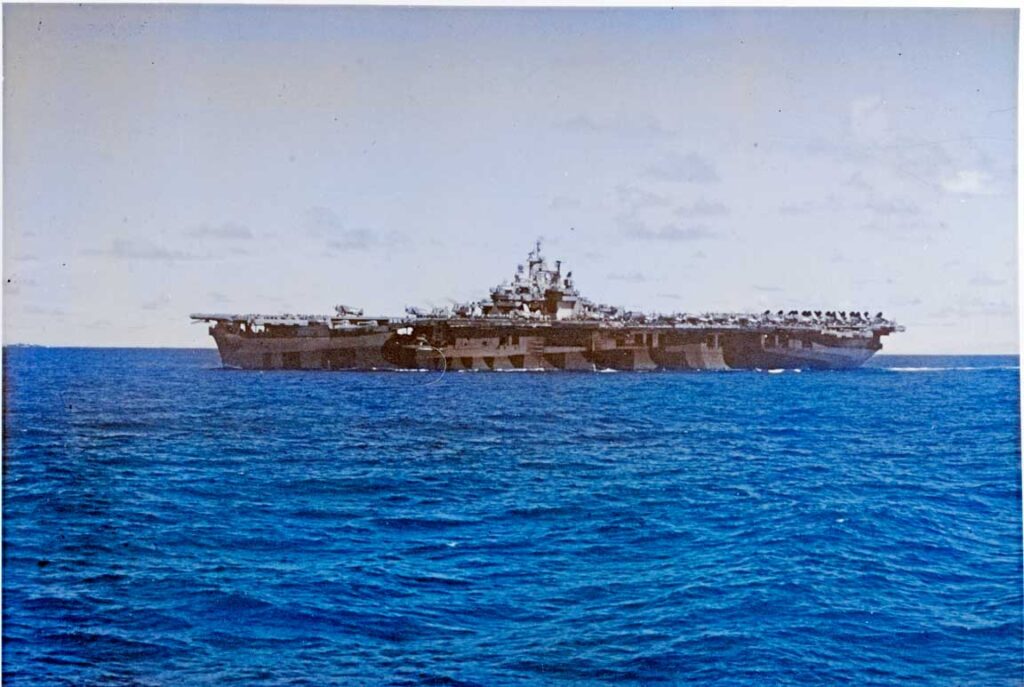
“That’s one thing I would really like to do. I would love to see the differences between the USS Bunker Hill and today’s modern aircraft carrier,” he said.

Smoke, Iron, and Resilience: Keeping the Fire Alive at Ribs BBQ

High Desert Resilience: How Summit Leon is Redefining Farming in the East Mountains

The Pack Leader: Carmen Dorsey-Spitz and a New Ceiling for New Mexico Running
About The Author
