

The Keepers of the Neon Flame: The Sunset Motel and the Soul of Route 66
Part I: The Airway Station and the Salt Lakes
MORIARTY – In the late 1950s along Route 66, a self-taught, WWII bomber pilot named Bill Pogue drew a straight line of red spray paint in the high-desert dirt of Moriarty, New Mexico, and handed picks to his eight- and five-year-old sons. “Start digging,” he told them.
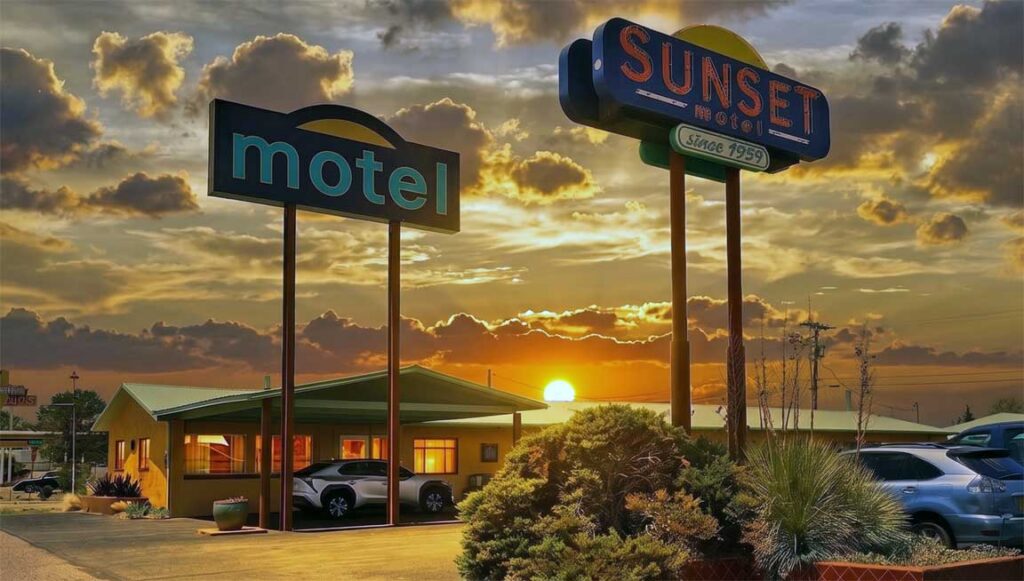
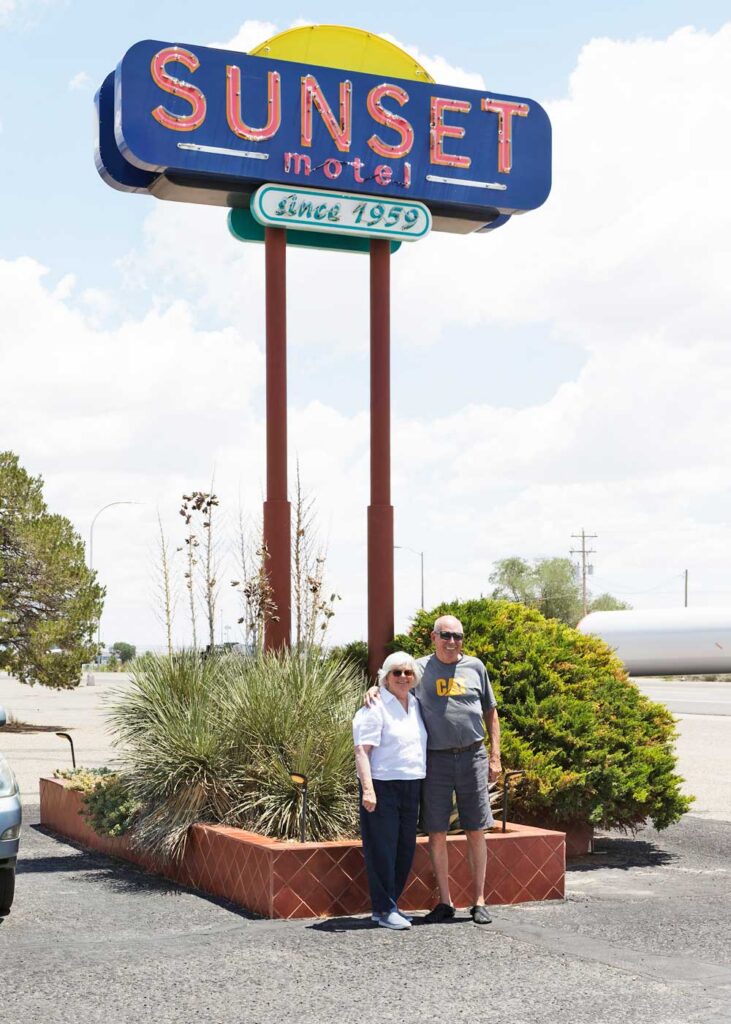
Today, the Sunset Motel—the oldest continually family-run lodging on the Mother Road—holds a near-perfect rating that rivals five-star luxury resorts, hosting everyone from weary cross-country road-trippers to A-list Hollywood stars like Queen Latifah and Matt Damon.
But its decades-long survival against Father Time while its peers crumbled didn’t happen by accident; it was hand-carved and built block by block, and the determination of a family refusing to let the world pass them by.
To understand the concrete, pumice block, and glowing neon of the Sunset Motel in Moriarty, New Mexico, you have to look north and south first. You have to understand the wind, the salt, and the high-altitude navigation of early American flight.
In 1943, a train ground to a halt at the depot in Willard, New Mexico. Four young women from Central Texas stepped off the passenger car into the vast, thin air of the Estancia Valley. Waiting for them was a man named Jerry Williams, who drove them six miles north of Moriarty to a lonely outpost built by the U.S. Postal Service: the Otto Airway Station (Station 224).
In those days, if you were a pilot like Charles Lindbergh delivering mail from New York to Los Angeles, you navigated by sight and sound. You flew at an elevation that kept the blinking beacons of the U.S. Airways system visible—one ahead, one behind—forming a visual breadcrumb trail across the dark spine of the continent. If the weather turned, or the primitive engines of the era sputtered, you relied on the absolute precision of the operators on the ground.
Down on the floor of the Otto station and living in the quarters built directly into its roof, these Texan women—highly educated by the early iteration of the Federal Aviation Administration—ran the teletype machines, tracked Morse code, and monitored the skies.
[Pilot] “This is Lindbergh 182 Foxtrot calling Otto 224.”
[Station] “Lindbergh 182 Foxtrot, right on schedule. We’ve been looking for you…”
They directed the air traffic, vectoring planes north or south around the violent thunderstorms that routinely bruised the New Mexico sky.
Planes and pretty girls – all one needs to complete this story is a pilot who has some “salt”.
Bill Pogue’s family had homesteaded the region in 1906 as dryland bean farmers. When the twin catastrophes of the Great Depression and the Dust Bowl took the farm, they pivoted to the salt lakes.
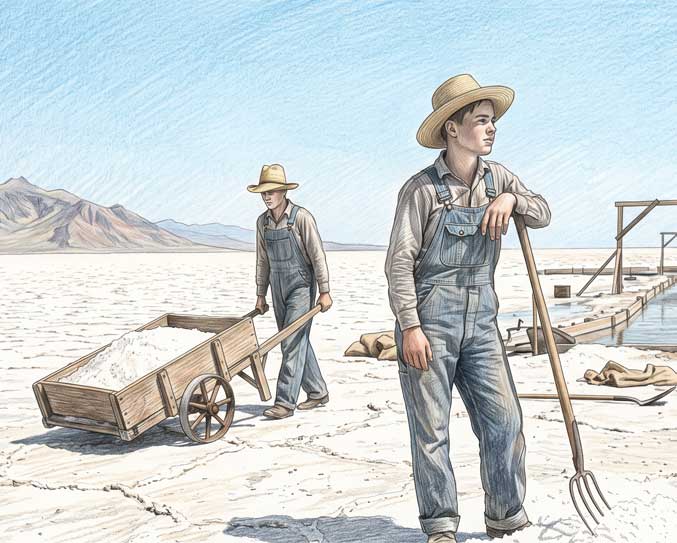
The work was brutal. They would intentionally flood the salt flats, wait for the desert sun to evaporate the water, and then harvest the resulting quarter-inch crust of pure, magnesium-heavy salt. By the time Bill was sixteen, his days were measured in pitchforks and wagons under a 118-degree summer sun. It was the kind of work that made a young man look at the horizon and aspire to something else.
World War II tore the family loose and scattered them across the globe. Bill’s brother, Jack, joined the Army Air Corps as one of the nation’s original paratroopers, eventually jumping into North Africa to train British forces, where he was later captured by Rommel’s troops and held as a prisoner of war. Bill left New Mexico to work for Lockheed in Ireland, repairing p-41 airplanes. When word reached him of his brother’s capture, Bill returned to the States, enlisted in the Army Air Corps, and trained on B-17 Flying Fortresses. He flew bombing missions over Germany until V-E Day, eventually volunteering to fly his B-17 into liberated territory to bring POWs home.
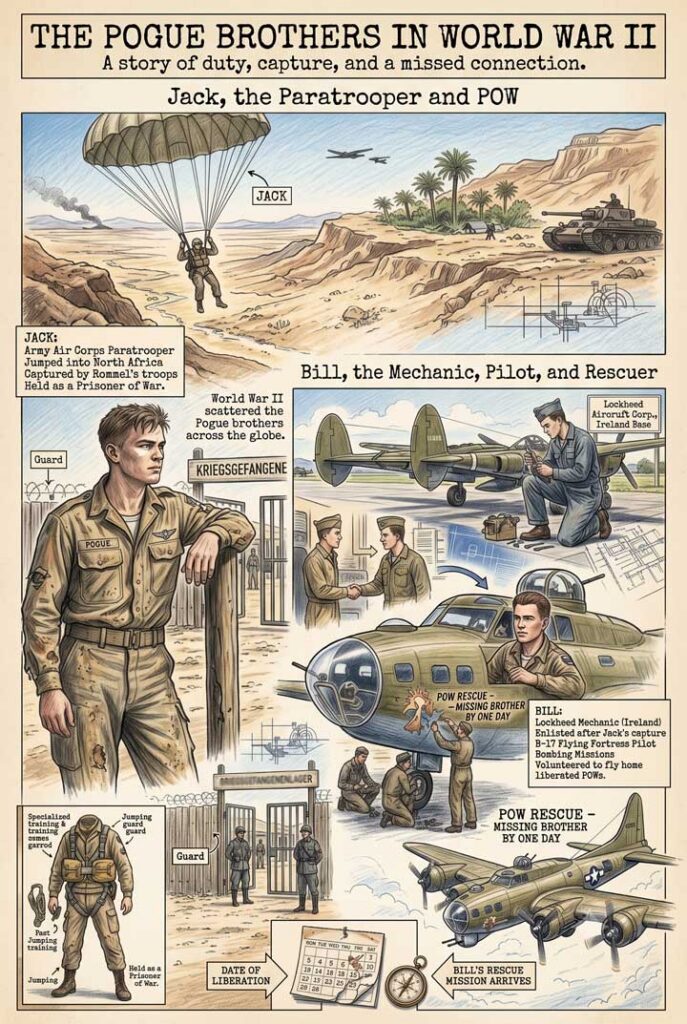
Bill and Jack Pogue served their country in WW2 and had vastly different adventures to tell about.
When the war ended, the Pogue brothers returned to the Estancia Valley. Their parents had moved up from the salt lakes to Moriarty, building a rudimentary, “heads-and-beds” roadside motel along the booming artery of Route 66 called the Yucca Motel. It was cheap, fast construction—2x4s laid directly onto the dirt for a foundation—but the highway was merciless, and the beds were always full.
Bill Pogue was himself attracted back to the Otto Airway Station for reasons beyond the aircraft. There were five single, intelligent, attractive women running the radio towers. The math was inevitable. Four of the five women married locally, building some of the essential businesses of modern Central New Mexico. Garland Tillery married Georgia and opened Tillery Chevrolet. Willis Garrett married “Squirt”—a woman standing four-foot-eight who helped build a heavy equipment empire, the Caterpillar franchise, and eventually Hotel Albuquerque.
And Bill Pogue married Elaine.
On the day they wed, Bill looked at the brilliant air traffic controller he had married and told her that her radio days were over and that he was going to take over her job; it was time to build a family and a legacy.
Part II: Six Feet Deep in Pumice and Concrete
The Sunset Motel was not born from a corporate blueprint or a contractor’s crew. It was hand-carved out of the New Mexico dirt by a father and his two young sons.
Bill Pogue bought a parcel of land along Route 66 next to what would become the Whiting Brothers gas station. He worked the midnight shift at the aviation base, came home, took a brief nap, and then went outside to build.
In the late 1950s, he called his sons—Bill Jr., who was eight, and Mike, who was just five—out to the front edge of the property. Armed with a can of spray paint, he drew a long, straight line on the dirt.
“Start digging,” he told them.
The trench was designed to be six feet deep and three and a half feet wide. The boys, working alongside their father and a few hired locals, dug it entirely by hand with picks and shovels. When a well-meaning friend of the family saw the small boys sweating in the ditch and confronted the elder Pogue, accusing him of robbing his children of their childhood, Bill Pogue didn’t blink. He was raised shoveling salt at seven years old; he knew that work was the only real currency against a fickle world. He looked at the neighbor and told him exactly where to turn around.
That hand-dug trench became the secret architectural marvel that would save the Sunset Motel decades later, when dozens of its vintage peers along Route 66 crumbled into ruins because the plumbing was too expensive or too difficult to repair. They lined the deep trench walls with pumice block and poured a concrete floor. Inside, they laid the plumbing and electrical mainlines. Bill installed “Christmas trees”—heavy, branching cast-iron pipe structures that connected the bathrooms of back-to-back rooms symmetrically.
Because of that ditch, a person can still walk completely underneath every single bathroom in the Sunset Motel, looking up new pipes that replaced the cast iron, servicing them, and replacement lines without ever breaking a slab of concrete.
The construction moved in cycles. Three dump trucks would arrive, dropping eleven yards of raw gravel onto the driveway, along with forty bags of cement. Mike remembers his mother, Elaine, standing out in the sun, arguing that the boys needed to sleep for school. Bill looked at her and said, “Elaine, go back to the house.” Three days of almost non-stop, hand-shoveled mixing followed.
Every single block of the Sunset Motel was mixed, stacked, and jointed by the Pogue boys and their father. Before school every morning, Mike and his brother would mix the first batch of mortar, so it was wet and waiting for the moment their dad woke up from his afternoon nap. They jigged the rafters by hand on the gravel driveway, hoisted the 2x4s, threw the 4×8 sheets of plywood onto the roof, and wired the attics.
In 1959, the first six rooms opened. They were immediately full. Every two years, they would add another six, until the motel reached its final, perfect scale of eighteen rooms in 1969—the exact same year Mike graduated from college.
By the time the motel hit twelve rooms, it was successful enough for Bill to retire from the aviation authority. He had climbed to the rank of Colonel in the Air Force Reserves, and the family business was thriving.
Part III: The Education of the Sidewalk
Route 66 in the 1960s was a living, breathing river of humanity, and the Sunset Motel sat right on its banks.
The Pogue boys slept in bunk beds in a tiny, two-bedroom apartment behind the front desk. The rooms had no air conditioning—only the wide-open windows letting in the cool, night air. At nine o’clock at night, Mike would lie in bed, look out through the open drapes, and watch a continuous line of cars stretching from the Whiting Brothers station next door all the way out to the asphalt of the highway. The gas station was pumping over 3,000 gallons a day.
The boys would run outside to mix with the travelers. In those days, before cars had factory air conditioning, motorists hung canvas water bags over their front radiators, relying on them for two reasons — to keep the engine cool and to also provide a supply of cool drinking water. The Pogue boys would walk the line of idling cars with fresh water, filling up the travelers’ canvas jugs for a nickel, or catching horned toads in the brush and selling them to wide-eyed city kids for a quarter.
But the real education happened on the Sunset’s concrete walkway.
In the evenings, Mike would come home from school and flop onto the couch to watch three-channel television. His dad would walk in, kick his foot, and say, “Get up, go out there and sweep the sidewalks.”
“What he was really telling me,” Mike reflects now, looking across the property, “is that the world is passing through. Wives wouldn’t let their husbands smoke cigarettes in the station wagons during the day, so the men would pull up chairs on the patio or the sidewalk in the evening and have a few smokes. Half my job was sweeping up those butts, but the real job was learning the world. They were all passing right by our doorstep.”
Mike took to it naturally. While his brother, Bill—who would grow up to be a brilliant academic, a Grand Master of the Masonic Lodge of New Mexico, and a board member for the George Washington Masonic National Memorial—would sweep his section quickly and go back inside to his books, Mike would sit down in the metal chairs.
He would meet people like a man who had spent twenty-five years operating a tow truck for Ford Motor Company in Detroit, or a family fleeing the fading industrial North for the promise of the West. He listened to their stories. He watched them read newspapers.
Part IV: From Wall Street to Meryl Streep
Mike went to the University of New Mexico to study accounting, finished early, and immediately set his sights on the headquarters of Price Waterhouse & Co. in New York. He wrote a bold letter to the hiring partner:
“I’m from Central New Mexico. I’ve got the grade point average. I’d like to buy you lunch in New York City on my nickel so you can interview me. If you hire me, you can reimburse me. All you invest is a lunch hour.”
The partner accepted. Mike hopped on a plane, walked down Wall Street in his best suit, and sat down at Delmonico’s Steakhouse, silently sweating over whether his remaining funds could cover the bill. He was hired before the plates were cleared. The firm also picked up the lunch tab.
By 1974, Mike was working on Wall Street, thriving in investment research. But back in New Mexico, the world was shifting. His father, Bill, was diagnosed with lymphoma after a routine medical screening. Three weeks later, he was gone at the young age of fifty-seven.
Elaine Pogue was left to run the eighteen-room motel entirely by herself, right as the 1973–1974 Arab Oil Embargo choked American travel to a standstill. Gas stations closed on Sundays. Tourism dried up. The motel rented zero rooms a night. Interstate 40 had bypassed the old alignment of Route 66 in 1969, and the golden era of the roadside cabin seemed dead.
The family put the Sunset Motel on the market for $250,000. For months, they didn’t receive a single call.
Bob Durham, the president of the Bank of Belen and a lifelong family friend who spent Friday nights playing bridge with Elaine and the late Colonel, called Mike in New York.
“Your brother has zero interest and zero personality for this business,” Durham said bluntly. “It’s your responsibility. You’ve got to get your mom out of that motel, take care of her, and make sure she’s financially okay.”
Mike didn’t want the motel. He was done with Moriarty; he was a corporate fast tracker on Wall Street. But the logic was clean, and the duty was ancient. Mike called Durham back a few days later.
“Look, we aren’t getting any offers. You have to loan me the money. I’ll sign the paperwork, and I’ll buy the motel from my mother. But the bank must carry the paper—every single penny. I don’t have a dime to put down.”
They made the deal. Mike called his mother and told her a buyer had emerged through the bank with a full-price offer of $250,000. Elaine was thrilled. It wasn’t until the final closing papers were laid out on the table that she looked across and realized the buyer was her own son.
Mike hired local managers to keep the doors open and returned to New York, where he co-founded a Wall Street investment research firm that would eventually go public on the New York Stock Exchange, achieving an eight-and-a-half-billion-dollar market cap. Six years later, he transitioned into the venture capital world of San Francisco.
But he never sold the Sunset Motel.
While living in Manhattan, Mike met Debbie, a brilliant fine-art illustrator whose work appeared on book covers, album covers and in almost every major magazine including Money, Redbook, Travel and Leisure and National Lampoon . They married, had a son, and eventually moved to Marin County, California Disturbed by what he saw as the visual pollution of 1980s children’s television, Mike used his Wall Street capital to help found Rabbit Ears Productions.
Rabbit Ears utilized a cutting-edge technology called “dissolve animation,” using one of only two specialized Sony camera rigs in the United States. Fine artists would paint hundreds of high-end illustrations, and the computer-controlled camera would pan, zoom, and dissolve between them, creating a rich, painterly texture that stood in stark contrast to cheap Saturday-morning cartoons.
For their first project, The Velveteen Rabbit, Mike aimed high. Through a chain of friends, he convinced Meryl Streep to narrate the story. When Streep suggested pianist George Winston for the score, Mike cornered Winston in his dressing room after a concert. Winston initially said no, until his girlfriend punched him in the arm and declared it her favorite book.
The production was a masterpiece. Mike took it to Target stores in Minneapolis, pitching it to their marketing director as a grand Christmas promotion centered on the story’s themes of life, death, and resurrection. The following winter, backed by a PBS special, Target sold two million plush rabbits worldwide.
The success snowballed. Jack Nicholson, and Cher. came aboard, then Robin Williams and Jeremy Irons, who brought in Sir John Gielgud,. Rabbit Ears went on to produce sixty-five beautifully animated children’s stories
Through all of it—through New York, Connecticut, Hollywood, and San Francisco—the Sunset Motel remained his anchor.
Part V: The Great Return and the Meaning of Purpose
By 2010, the global economy had collapsed. The Lehman Brothers bankruptcy caused shockwaves through Silicon Valley, and many of Mike’s venture investments died when follow-up funding rounds evaporated.
At the same time, Mike and Debbie’s son grew up and left for the Ivy League. The big house in California felt quiet.
Debbie looked at Mike one morning and said, “Let’s go back to New Mexico. Let’s take a couple of years, restore the motel, run it ourselves, and wait for the economy to clear up.”
They returned to the high desert. Debbie, an elegant, metropolitan illustrator from Alabama, suddenly found herself holding the keys to an eighteen-room roadside motel while Mike took on a massive corporate contract trenching fiber-optic cables across southern Utah.
“How are you going to manage?” Mike asked her.
“You’re looking at the manager right now,” she replied, and took the keys.
Part VI: The Last One Standing
The Sunset Motel is a time capsule, but not a synthetic one.
When modern travelers open the doors to their rooms, they frequently log on to Expedia or TripAdvisor to leave glowing, five-star reviews praising the Pogues for their “incredible job of retrofitting and restoring the property back to a perfect mid-century mid-century aesthetic.”
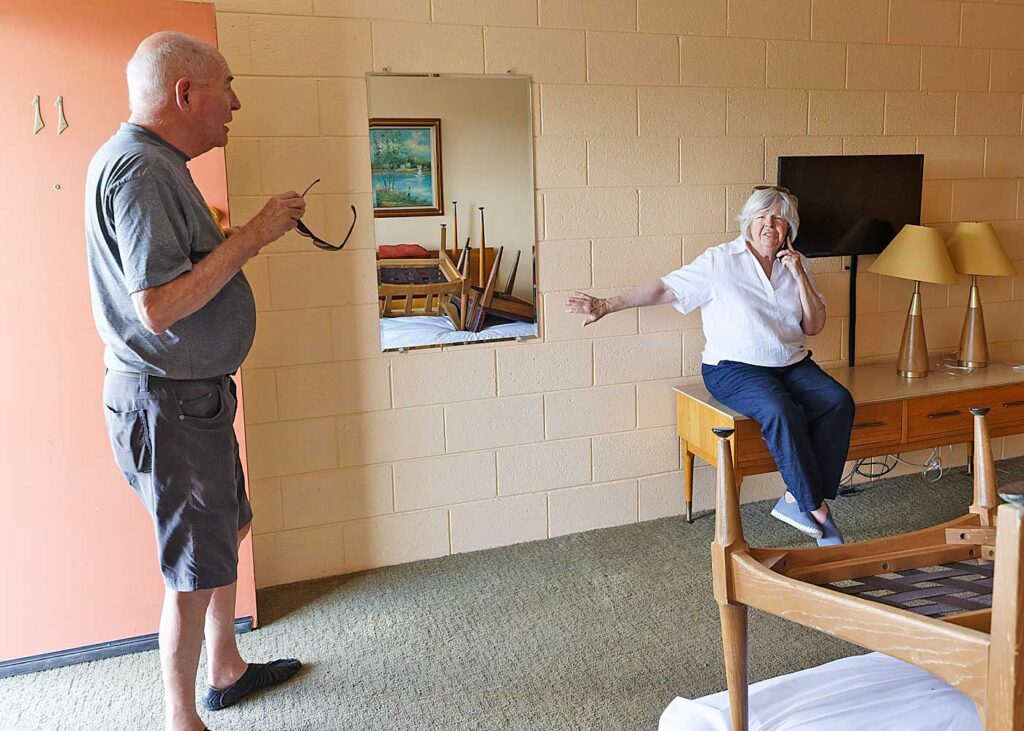
Mike laughs when he reads them. “We didn’t restore anything. That’s the exact same oak furniture that has always been in that room. That’s the original wood paneling. That’s the same lamp we opened the doors with in 1959. We just took care of it.”
That fanatical care is maintained by a dedicated deep-cleaner named Edith. Every single day, Edith takes a toothbrush, a can of cleanser, and oils, and goes to work on a single room. She scrubs every line of tile grout, polishes the original oak furniture, and oils the wood paneling. It takes her exactly eighteen days to move from Room 1 to Room 18. The moment she finishes the last room; she walks back to the front of the property and starts again at Room 1.
That work has paid off. Out of every lodging property in New Mexico, the highest-rated on major travel platforms is the ultra-luxury Five Graces in Santa Fe, where rooms command $1,300 a night for a 9.6 rating. The second highest-rated property in the entire state is the Sunset Motel in Moriarty, holding a spectacular 9.4 rating for a fraction of the cost.
The old highway isn’t dead either; it has just moved onto the silver screen. The Sunset’s flawless mid-century preservation has made it a darling of the New Mexico film industry, hosting sixteen major film shoots in recent years.
When Queen Latifah and Beau Bridges shot an expansive production here, her crew set up a catering tent that stretched over a thousand feet down the property, renting out all eighteen rooms for total privacy.
Jeff Bridges has filmed here. Matt Dillon filmed here , staying at the motel and chatting with the family between takes.
Yet, for all the Hollywood glamour and the Wall Street success, the soul of the Sunset Motel remains rooted in the simple, profound act of human connection.
“People are starving now for personal connections,” Mike says, leaning back against the office desk. “They’re tired of AI on cell phones and automated Expedia confirmations. When a customer walks through that front door, I usually know them. I’ve rented rooms to them for ten, twenty, or thirty years. I ask them about their grandkids in Peoria—and we keep their names in our logs so we remember them next time. Before you know it, there are ten strangers sitting out on the back patio together, grilling hamburgers and getting to know each other.”
Epilogue: The Mayor’s Hay Wagon
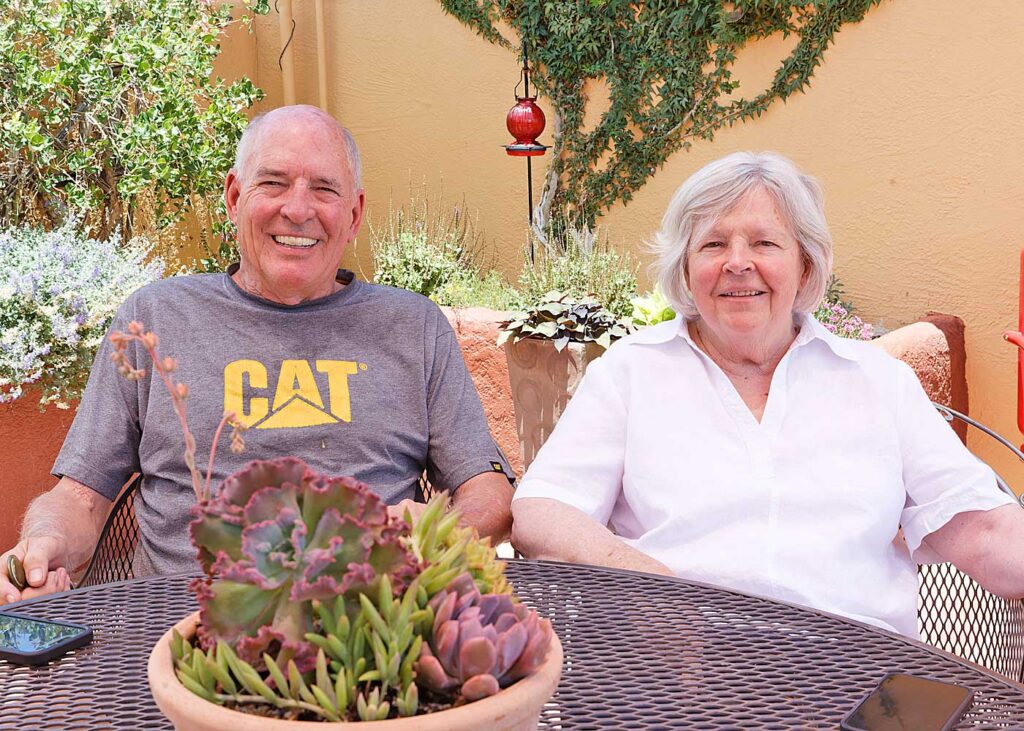
Mike is now seventy-five; Debbie is seventy-four. They own a historic 1906 Craftsman home in Albuquerque that they’ve been restoring for a decade, and they split their time, coming out to Moriarty just a few days a week. The Pogue’s son is in New York, working in films, commercials and music videos, with no plans to return to the hospitality business of the high desert.
The day-to-day operations have been handed down to their brilliant manager, Bailey, who holds two master’s degrees in psychology .
Years ago, when Mike bought the motel from his mother to give her a retirement, he built her a beautiful custom home at the other end of Moriarty. Within a few months, Elaine was climbing the walls with boredom. She missed the noise, the people, and the local political debates that had defined life on Route 66.
Mike and his brother looked at her and said, “All right, Mom. You’re bored. Here’s a hay wagon, a tractor, and a guitar. You’ve been sitting at the kitchen table barking about local politics since we were old enough to listen. We’re running you for mayor.”
They loaded Elaine Pogue onto the back of the hay wagon and drove her down the streets of Moriarty. She won the election hands down, serving as the town’s formidable, beloved mayor for years.
The Sunset Motel remains the oldest continually family-run operating motel on U.S. Route 66. It survived the dust, the loss of the dryland bean farms, the structural shifts of a world war, the oil embargoes, and the bypass of the interstate. Our designation is the last original Route 66 motel still owned and operated by the family who built it.
It survived because a veteran pilot told his young sons to dig a trench six feet deep into the earth, ensuring that whatever broke on the surface could always be fixed from below. And it survived because those one of those sons learned that if you sit on a concrete sidewalk long enough and listen to the stories of the people passing through, you will eventually find the very heart of America waiting at your doorstep.

The Architect of Bravado: Michael Wood and the Evolution of East Mountain Recording Arts

All Creatures Great and Small: Young Veterinarian Fulfills Childhood Vow to Serve Rural New Mexico
Community and Color Soar at Edgewood’s Annual Kite Festival
About The Author
